
The future of SEO in India: how AI is changing search and what to do about it

SEO in India is not dying. It is splitting into two jobs: ranking in classic search results, and getting quoted inside AI answers. India's internet subscriptions crossed 1.09 billion by March 2026, according to TRAI. Google counts India among the top three markets for its AI Mode search. And most new users prefer to search in Indian languages, often by speaking instead of typing. Put those facts together and you get a clear picture of the future of SEO in India: AI-driven, voice-led, and multilingual.
Is SEO still relevant in India?
Yes, and the numbers say search is growing, not shrinking. Google reports that AI Overviews now reach more than 1.5 billion people a month, and that in its biggest markets, the US and India, they have driven a more than 10 percent rise in usage for the kinds of queries where they appear. People are searching more than ever.
What has changed is where the answer lives. For many informational queries, the answer now sits on the results page itself, assembled by AI from several websites. Fewer of those searches end in a click. Rankings still matter, but a first-page position no longer guarantees the traffic it did in 2020.
So the real question has moved. It is no longer "should we do SEO?" but "what does visibility mean when an AI writes the answer?" For the next few years, visibility in Indian search means ranking in classic results, being cited inside AI answers, and being the brand people search for by name.
How AI is changing search algorithms
Google has been folding machine learning into ranking for a decade, from RankBrain in 2015 to BERT in 2019. What changed recently is the interface. The algorithm no longer just orders links. It reads pages, picks passages, and writes the answer.
Two AI surfaces matter for Indian businesses right now. The first is AI Overviews, the AI-written summary at the top of normal results. It leans heavily on pages that already rank well, so classic SEO still feeds it. The second is AI Mode, a separate conversational tab in Google Search. It launched in India in June 2025, runs on Gemini, handles voice and images, and crossed one billion monthly users worldwide by mid-2026. Google added Hindi support in September 2025 and seven more Indian languages soon after.
The two surfaces also choose sources differently. An Ahrefs study of over 500,000 query pairs found that AI Overviews and AI Mode cite the same URLs only about 14 percent of the time. Ranking well helps with the first. The second cares more about freshness, clear answers, and how well known your brand is.
Two findings sum up what the new systems reward. SE Ranking analysed more than a million AI citations and found that pages updated within the last three months were roughly three times more likely to be cited. And an Ahrefs study of 75,000 brands, published in December 2025, found that brand mentions across the web correlate about three times more strongly with AI visibility than backlinks do. Fresh, quotable, and talked about now beats old, vague, and heavily linked.
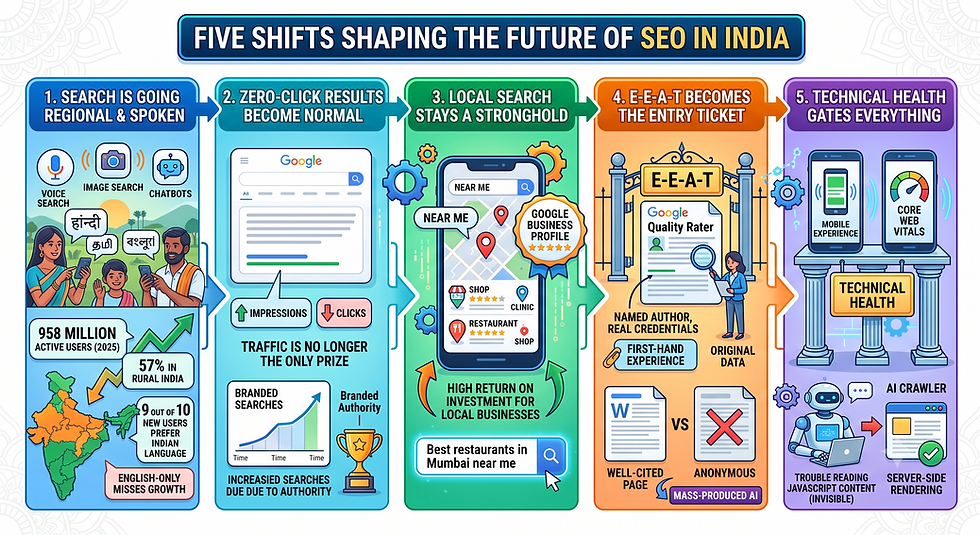
Five shifts shaping the future of SEO in India
Search is going regional and spoken
IAMAI's Internet in India report counted 958 million active internet users in 2025, with 57 percent of them in rural India. A Google-KPMG study projected that nine out of ten new Indian internet users would prefer an Indian language. IAMAI also found that 44 percent of users have already tried AI features such as voice search, image search, and chatbots. English-only content misses most of this growth.
Zero-click results become normal
When the answer appears on the results page, impressions rise and clicks fall. Traffic is no longer the only prize. Being named in the answer builds the branded searches that come later.
Local search stays a stronghold
"Near me" queries still mostly show the map pack, and a well-run Google Business Profile still wins them. For shops, clinics, restaurants, and service businesses, local SEO remains the highest-return work in Indian search.
E-E-A-T becomes the entry ticket
Google's quality raters now check whether content looks mass-produced by AI. Pages with a named author, real credentials, first-hand experience, and original data get cited. Anonymous, generic pages get skipped by both the algorithm and the AI.
Technical health gates everything
Most Indian searches happen on phones, so mobile experience and Core Web Vitals still set the floor. One newer detail: AI crawlers generally do not run JavaScript, so content that only loads through scripts can be invisible to them. Server-side rendering fixes that.
How businesses should adapt
None of this needs a huge budget. It needs different habits, in roughly this order.
Put the answer first
Under each main heading, give a direct answer of 40 to 60 words before the detail. AI systems lift self-contained passages, and nearly half of all AI citations come from the top third of a page.
Publish in your customers languages
Start with Hindi plus one state language that matters to your market. If you sell in Karnataka, that means Kannada. Use native writers to adapt the content, because machine translation alone reads wrong to both people and models.
Show your E-E-A-T
Add author bios with real credentials, visible dates, and at least one number or case study from your own work on every important page. Original data is the easiest thing for an AI to quote and the hardest for a competitor to copy.
Refresh instead of only publishing
Update your ten most important pages every quarter. Stale pages fall out of AI answers within months.
Keep local listings sharp
Complete your Google Business Profile, collect reviews every week, and keep your name, address, and phone details identical everywhere they appear.
Earn mentions, not just links
Show up on YouTube, in community discussions and in industry publications. AI systems treat repeated brand mentions as evidence that you are real and reputable.
Change what you measure
Track AI Overview and AI Mode appearances, branded search volume, and leads alongside rankings and clicks. Judging SEO by clicks alone will make good work look like failure.
Common questions
Will AI replace SEO in India?
No. AI changes where answers appear, not whether businesses need to be found. Someone still has to write the pages that AI quotes. The work shifts from chasing rankings to becoming the source machines trust.
Is SEO worth it for small Indian businesses in 2026?
Yes, and arguably more than before. Local and regional language search are wide open, most competitors have not adapted, and organic visibility compounds while ad costs keep rising.
What should we do first?
Pick your most important page. Add a direct answer at the top, a named author with credentials, and a fresh date, and plan a Hindi or regional version. That one page becomes your template for the rest.
The short version
Search in India is growing on every measure that matters: users, languages, query volume and AI adoption. The traffic is moving, not vanishing. The future of SEO in India belongs to the businesses that AI systems can read, quote, and trust. That work starts on your pages, not in Google's algorithm.


Comments